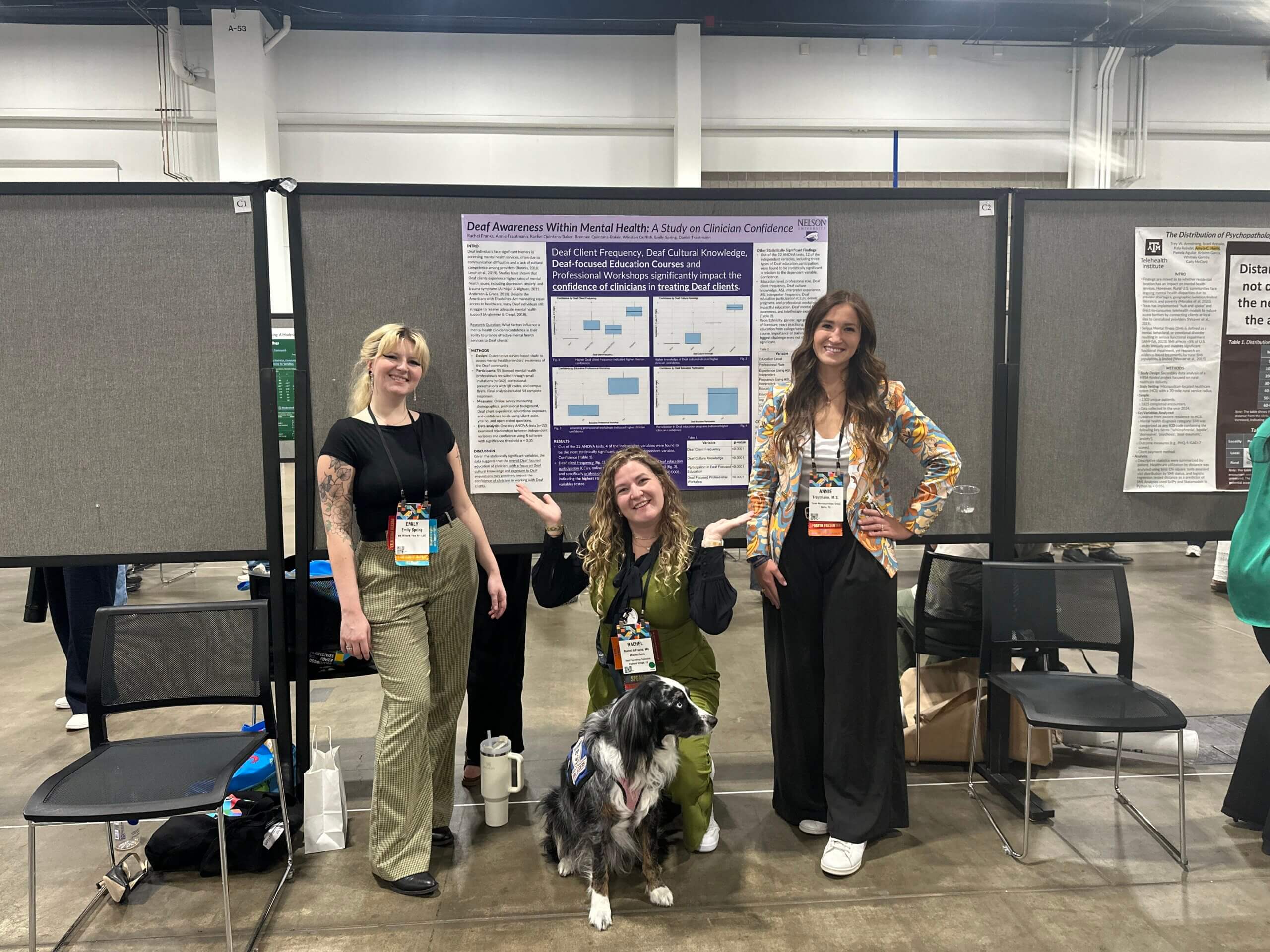
Finding Her Calling: From Nelson University to Deaf Mental Health Research
From discovering a passion for psychology at Nelson University to pursuing research focused on the Deaf and hard-of-hearing community, Rachel Franks has followed a path shaped by purpose, mentorship and a desire to serve. In this Q&A, she reflects on the experiences that helped her find her calling and where it’s leading her today.
1. You earned your Associate of Arts in Music, Bachelor of Science in Psychology, and Master of Science in Clinical Psychology from Nelson University. Looking back, how did each degree shape the path you’re on today?
“When I first came to Nelson University (at the time SAGU), I was a double major in vocal performance and intercultural studies. I didn’t know exactly what I wanted to do with that, but music had always been a part of my life, and using my talents for ministry had also been a part of my life.
Psychology had not even been on the table until I took intro to psychology with Dr. John Savell, and he pretty much single-handedly changed the trajectory of my life. He asked me to stay after class one day, freshman year, and he asked me what my major was. I told him, and his only response was, “nah, I give it till January; you’re gonna be a psychology major.” At first, I didn’t know what to think. Music had always been a passion for me, but also just so much a part of my life. I didn’t quite have the words to explain how psychology felt for me until a little further into the semester, when Dr. Savell’s words kept playing over in my mind. I approached him one day in the cafeteria, asking why he would’ve said that to me. Long story short, we had a heart-to-heart conversation in which he told me, “The difference between your calling and something that you could just thrive in is what makes you come alive.”
Until that point, I had always thrived in music. I loved it, but it didn’t make me come alive in the same way that psychology did, even just in that first class. From that point, I was hooked. I’m not a very “1 foot in” kind of person. When I commit to something, I give 100% of myself to that thing. Once I decided that was what I wanted to do, and I felt like that was where the Lord was taking me, nothing was gonna stand in my way. I knew I would likely have to get my PhD if I wanted to become licensed or teach, but I’ve always loved school, so that wasn’t really an issue for me when deciding.
Music is still very much a part of my life. But now it just gets to be a passion and a gift from God, rather than something I do for a career.”
2. What first sparked your passion for serving and advocating for the Deaf and hard-of-hearing community?
“How much time do you have? There is no simple answer to this question.
I had a friend growing up whose mom was an ASL interpreter and whose dad was deaf. Their family was my first exposure to the Deaf community, but it definitely planted seeds that got watered in so many other ways. I got exposure to the language and culture, and I got very involved in my local Deaf community…. I went into college at Nelson (then SAGU), knowing I wanted to be involved in the Deaf community in the future, but not having any idea what that would look like. SAGU did not have any options to take ASL at that time; I just did my best to maintain my language skills through community involvement, going to Deaf coffee chats and Deaf events.
However, I knew that if I wanted to really be involved in the Deaf community in some capacity later in my life, I would need to do something to increase my language skills even more prior to that. While I was completing my master’s degree, I decided that it would be a good time to work on my ASL fluency. I enrolled in the ASL interpreting program at Tarrant County College in Fort Worth, Texas, which is one of the top interpreting programs in the nation. Although I did not want to become an ASL interpreter, I went through the program in order to work toward getting my ASL fluency to a clinical fluency level.
Now, I am at Gallaudet University, the world’s only bilingual liberal arts university specifically designed for Deaf and hard-of-hearing students, where all programs and services accommodate this community. It is a dream opportunity, and from my perspective, the only opportunity that would have prepared me fully for a career in psychology, focusing on Deaf and hard-of-hearing populations.”
3. During your time at Nelson, were there any professors, mentors, or experiences that helped you discover your calling to work with the Deaf and hard-of-hearing community?
“Generally speaking, I would say all of the Nelson professors played a role in me discovering my calling. More so, they were very supportive of me, nurturing my academic experience in a way that supported my future goals.
Specifically, as it pertains to the psychology department, Dr. John Savell, my main mentor, Dr. William Armistead, and Dr. Deborah Pauli always supported me in my interests. Early on in my collegiate career, Dr. Pauli encouraged me to ‘find an area of specialty and make yourself an expert in it.’ While I wouldn’t classify myself as even close to an expert on psychology as it pertains to the Deaf community, I do think I took that sentiment to heart to become a researcher passionate about a specific area of interest.
I think almost every paper I wrote throughout my undergraduate and masters degrees at Nelson, had to do with some aspect of the Deaf community, mental health for the Deaf community, Implicit Bias as it pertains to the Deaf community, religious history in the Deaf community, approaches that had been normed for the Deaf community, systemic inequities and oppression as it pertained to the Deaf community, and so many more. Both my undergraduate research project and my Master’s Thesis analyzed different aspects of mental health and the provision of services to Deaf and hard-of-hearing individuals.
Not once did a faculty member sit me down and say, ‘Rachel, you’ve gotta write about something else.’ If the paper was about counseling techniques, you can bet I was writing a literature review on ‘how counseling techniques are applied to Deaf and hard-of-hearing populations.’ That was some of the best advice for becoming the researcher I am today.”
4. Your research was recently published. Can you tell us about the focus of your research paper and why this topic is important to you? What challenges or gaps did your research seek to address within the deaf and hard-of-hearing community?
“The research published is titled ‘Predictors of Confidence in Mental Health Clinicians Interacting with D/deaf Populations: Training, Experience, and Guiding Factors,’ and it was published by The Journal of the American Deafness and Rehabilitation Association (JADARA). It was actually a revision of my master’s thesis from Nelson.
The focus was on assessing what factors impact clinician confidence when working with D/deaf populations. Obviously, we know clinician confidence doesn’t always correlate with positive client outcomes, but it was meant to be more of a foundational study to show what clinicians can focus on to potentially increase their own awareness, understanding, and confidence for treating D/deaf clients.
At the time, I didn’t have access to a large enough sample of D/deaf clients or a budget to source them in order to do research that also considered positive client outcomes, so I mainly focused on clinicians and their experiences treating clients. Moving forward, the goal would be to try to develop research that speaks to which factors can not only increase clinician confidence, but also increase positive client outcomes and experiences.
I am very grateful to Dr. Savell and Dr. Pauli for their support in launching and navigating the research process, as Nelson is not traditionally a “research institution.” However, they wholeheartedly supported me in making my dream of doing research and eventually publishing it a reality. It took a lot of hard work, sleepless nights, discouragements, and so many revisions, but we made it. As a result, an article that was entirely student-led, student-conducted, student-authored, and student-published (with editorial oversight from Dr. Savell) has now been published, and many of the co-authors are also Nelson graduates.”
5. For students who are considering psychology, clinical research, or careers serving specialized populations, what advice would you give them about pursuing their calling?
“Speaking to psychology, if Dr. Savell tells you that your major will change by January, buckle up and get ready for the ride of a lifetime. In regard to research, I would encourage any student who wants to do it, as I am proof that it is possible. If you want to make it happen, the faculty at Nelson are here to support you and empower you to accomplish it. However, you need to know that you will need to put in work. It is not something you just say and then do. You have to have drive, determination, and a willingness to fail forward to continue your own growth.
Specifically pertaining to specialized populations, know that you will never arrive at a pinnacle of knowledge. Especially if you yourself are not part of a specialized population, understand that there will be so many things that you will constantly be learning, growing, and evolving in. There may be moments you feel embarrassed, uncomfortable, uneducated, or wrong, but know it is all about your heart posture. Do you have a willingness to learn and grow through the discomfort, and to continue learning from the population? Know that no one experience is generalizable to an entire population, but also that every perspective matters for your learning and growth.
The best advice I have ever received was from Dr. John Savell, and I believe everyone would benefit from it. When I graduated from undergraduate studies at SAGU, I asked Dr. Savell what his one piece of advice would be, and he told me, ‘You will always have something to learn from every single person you meet. Never stop learning. Never stop being a student of life. Never think you know everything. The more you learn, the more you realize you have more to learn. Keep it that way.’”
Greater with Faith. A Christ-centered community on campus and online.
Request Info | Apply | Visit